How it works
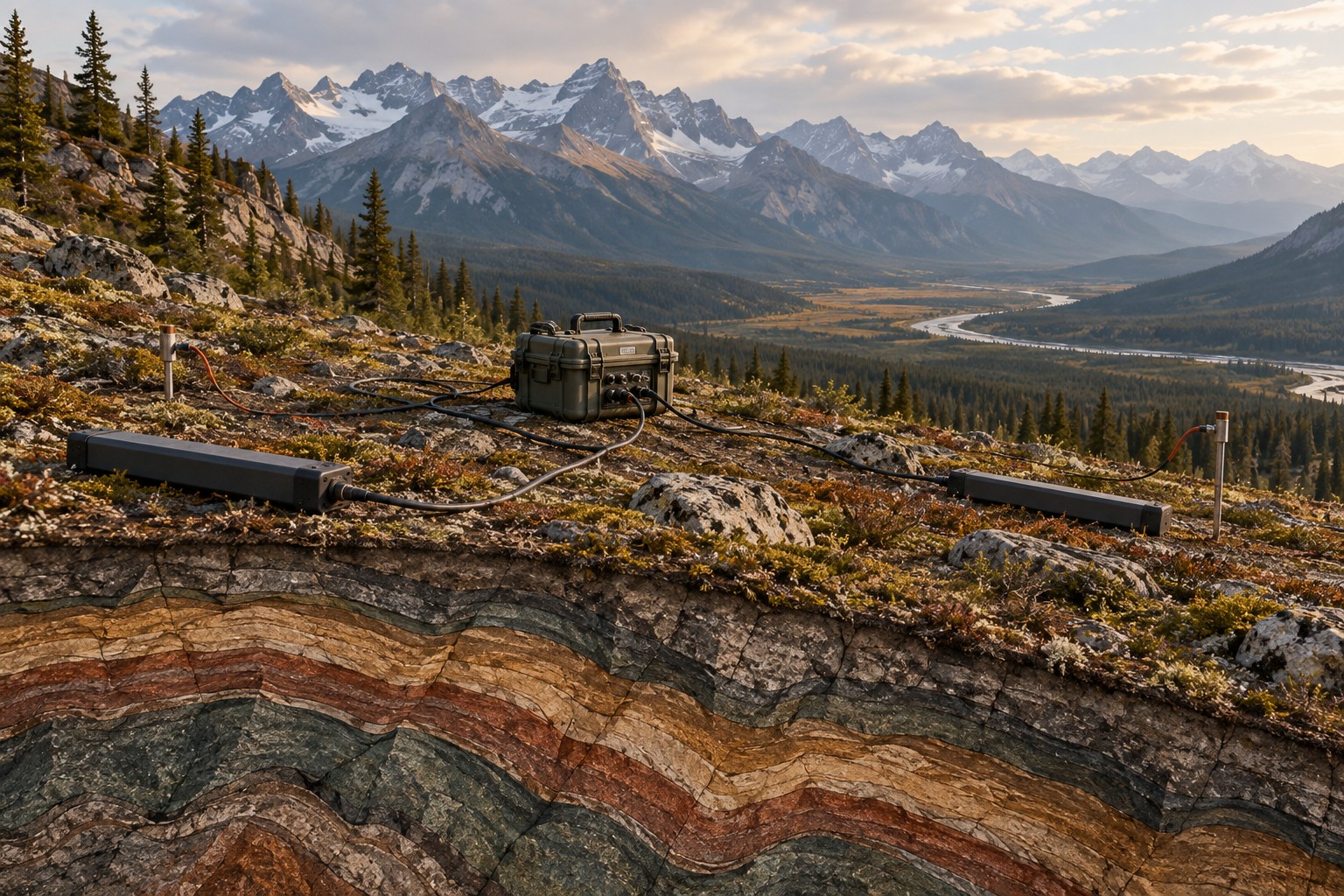
The “audio” in the name describes the frequency range; AMT is not a sound survey. Electric and magnetic sensors record natural field variations. We compare the signals over a range of frequencies and use them to estimate possible resistivity distributions. AMT and MT measurements can overlap and may be collected with compatible equipment, depending on the survey design.
Where it is commonly used
AMT can support mineral exploration beneath cover, investigation of basin margins and faults, and selected groundwater or geothermal questions. It is useful when the area of interest is smaller or the target is shallower than the main focus of a deep regional MT programme.
Why use this approach?
AMT can add shallower detail to a broader electrical model. Combining AMT and MT can help connect near-surface conditions to deeper structures instead of interpreting each depth range in isolation. Its natural source avoids the need to lay out a large transmitting loop.
What it cannot tell you on its own
Higher frequency does not guarantee high resolution. Weak natural signals in parts of the frequency spectrum, cultural noise and conductive cover can limit the useful information. AMT cannot by itself distinguish fresh groundwater from every other material with a similar electrical response.
From data to interpretation
We design the station layout around the expected dimensions of the target, check local noise and ground contact, and collect enough data to assess repeatability. We inspect response curves, identify unreliable frequency bands and document any excluded observations. Modelling then tests whether proposed features are actually required by the data.
What you receive
Quality-controlled AMT responses; station maps; resistivity sections or volumes appropriate to coverage; interpretation of shallower contacts and structures; a record of unresolved areas and suggested checks.
How it compares & fits with other methods
MT generally emphasizes a broader and often deeper range. TDEM uses a controlled pulse and may provide useful complementary shallow conductivity information. AMT is selected when its natural-field measurement and expected sensitivity fit the target and site conditions.
An example decision
A Manitoba exploration team wants to know whether a mapped contact continues beneath overburden. AMT can test for an electrical boundary, while magnetics and geology help assess what kind of boundary it might be. Any proposed drill target remains a hypothesis to test.
Examples describe possible assignments, not completed Dwell projects. Equipment, acquisition partners, coverage and deliverables are agreed in the proposal.
Technical background ↗